
Control cables built around your application.
From standard push-pull and pull-only assemblies to high-efficiency ball bearing systems, Cablecraft engineers mechanical control cables to match your load, travel, routing and interface requirements.
Standard product families. Application-specific lengths, construction and fittings.
What is a control cable?
A control cable transfers mechanical motion or force between points using a flexible inner member and, where required, an outer conduit. Cablecraft offers push-pull cables for bidirectional operation, pull-only assemblies for tension-based functions, and ball bearing cables for applications where high efficiency and low lost motion are priorities. The correct system depends on the motion, load, travel, routing and operating environment.
Find the right control cable architecture
Start with the type of movement the system needs. Then explore the cable construction and product options for your application.
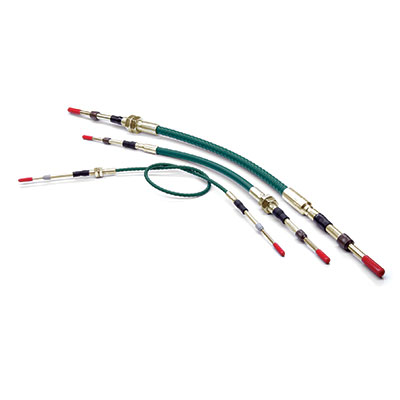
Sliding Control Cables
Versatile mechanical cable systems for push-pull and pull-only functions across equipment and vehicle applications.
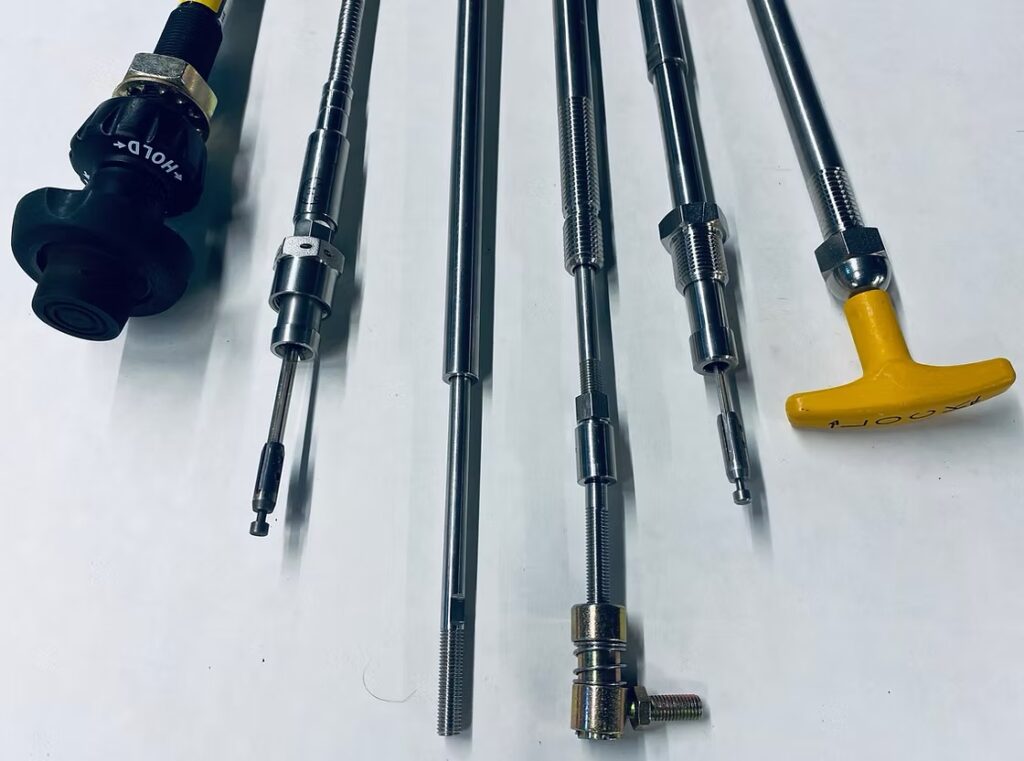
Ball Bearing Control Cables
Engineered for precise push-pull movement, low lost motion, higher loads and long or complex routed paths.
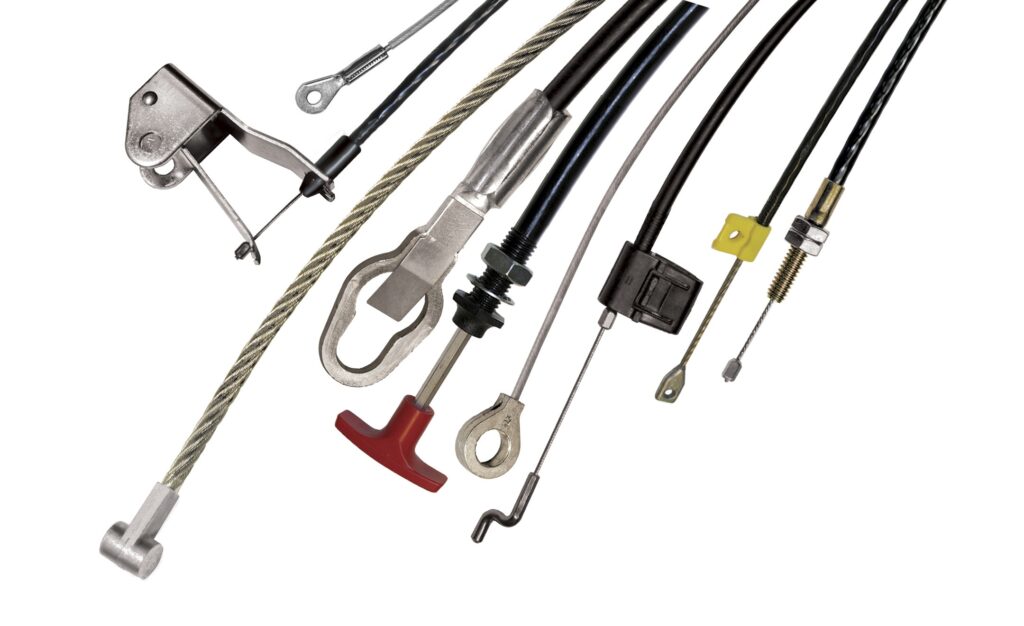
Safety & Restraint
Capture, retention and restraint assemblies for equipment and safety applications.
Explore solutions
Conduit & Innermember
Construction options that influence routing, protection, efficiency and durability.
Explore components
Miniature Cables
Compact cable constructions for restricted spaces and small-scale motion applications.
Explore miniature cablesFrom cable family to actual product
Review representative assemblies with dedicated technical pages. Each listing can be configured around the application, subject to engineering review.
Standard Push-Pull
Configurable Bristow, Utility and Low Friction constructions for OEM motion control.
View assembly Sliding · Push-Pull4B Industrial
An economical armored-core push-pull assembly for industrial mechanical controls.
View assembly Sliding · High PerformanceBlue Max™
Low-friction push-pull cable designed for demanding routing and operating environments.
View assembly Sliding · Pull-OnlyT-Flex Pull-Only
Flexible tension-control construction for clutch, throttle, engine-stop and release functions.
View assembly Ball Bearing · PrecisionKRF3000
High-efficiency push-pull control with low lost motion for precise routed movement.
View assembly Ball Bearing · Higher LoadKRF1600
Higher-load ball bearing control cable for precise, efficient push-pull applications.
View assemblyView more pull-only cable assemblies
Want to compare the full offering? Browse Cablecraft's WooCommerce product catalog by family.
Browse all control cable assembliesFour questions to help specify the right cable
These inputs shape cable construction and performance. A complete specification also considers how the cable is installed and operated.
Motion & Load
Does the system push, pull or both? What force and duty cycle are required?
Travel & Routing
How far does it move? Consider length, bends, available space and radius.
Precision & Feel
How important are efficiency, backlash, lost motion and responsiveness?
Interfaces & Environment
Specify end fittings, mounting, temperature, contamination and exposure.
Control cables across demanding industries
Explore application examples and cable requirements in the markets Cablecraft supports.
Control cable questions, answered
What is the difference between push-pull and pull-only control cables?
Push-pull cables transmit motion in compression and tension. Pull-only cables transmit force in tension and generally depend on a second cable, spring or return mechanism for the opposite motion. The correct arrangement depends on the load and system design.
When should an engineer consider a ball bearing control cable?
Ball bearing controls are worth evaluating when high efficiency, low lost motion, long routed paths or precise push-pull movement are critical. Cablecraft's KRF3000 and KRF1600 series offer different load and bend-radius capabilities.
Can Cablecraft customize cable length, travel and end fittings?
Yes. Cablecraft can evaluate custom cable lengths, operating travel, conduit/inner-member construction, end fittings and mounting interfaces. Submit your drawing, required motion, loads and routing information through the request-a-quote form.
Have an application in mind? Let's define the right cable.
Share your requirements with Cablecraft. Our team can help evaluate an existing series or a custom assembly for your installation.
- Application or drawing
- Motion and load
- Travel and routing
- Fittings and quantity