
Aircraft Control Cables & Aerospace Actuation Systems
Cablecraft supports commercial, military and general aviation programs with engineered aircraft control cables, ball bearing push-pull controls, pull-pull cables, safety and restraint assemblies, miniature cables and remote actuation systems. Our engineers review load, travel, routing, bend radius, temperature, environment, interfaces, lifecycle and program requirements to help develop a production-ready solution.
- Low-lost-motion and complex-routing options
- AS9100D quality system for applicable scope
- Custom engineering and prototypes
- ITAR registration for applicable programs

What Aerospace Control Products Does Cablecraft Supply?
Cablecraft supplies aircraft control cables and cable-based actuation products for flight-control, engine-control, cabin, seating, access, release, restraint and support-equipment applications.
Available product architectures include ball bearing push-pull controls, sliding push-pull cables, pull-pull and pull-only cables, Cycle-Flex™ miniature cables, safety and restraint assemblies and remote latch or release systems. Engineered rod ends, spherical bearings and linkage assemblies are available through Radial Bearing.
- Ball bearing control cables
- Push-pull aircraft controls
- Pull-pull and pull-only cables
- Safety and restraint assemblies
- Miniature high-cycle cables
- Remote actuation systems
Aerospace Control Cable and Actuation Solutions
The appropriate architecture depends on the required direction of motion, load, routing, precision, available space, environment, operator interface and qualification requirements.
Ball Bearing Control Cables
High-efficiency push-pull controls for applications requiring accurate motion transfer, low lost motion, repeatability, load capability and complex routing.
- 90%–98% published efficiency range
- KRF3000 and KRF1600 series
- Dry-running operation
Push-Pull Aircraft Control Cables
Push-pull cables transmit mechanical movement in both tension and compression for aircraft controls requiring a flexible routed connection.
- Throttle and engine-control functions
- Custom length, travel and fittings
- Application-specific conduit and core
Pull-Pull & Pull-Only Cables
Pull-pull and pull-only cables transmit tension and generally use an opposing cable, return spring or mechanism for return movement.
- Flight-control and release systems
- Brake and cabin-control functions
- Flexible routing and fitting options
Safety & Restraint Cables
Static cable assemblies capture, secure or limit movement in doors, hatches, equipment, panels and other aerospace restraint applications.
- Door and emergency-hatch restraint
- Equipment and load securement
- Custom cable, coating and fittings
Cycle-Flex™ Miniature Cables
Small-diameter cable constructions support compact, repeated-motion and tether applications where routing space and cable size are constrained.
- Overhead-bin latch mechanisms
- Small-object safety tethers
- Coated or uncoated constructions
Aerospace Actuation Systems
Cable assemblies paired with levers, handles, push buttons or release mechanisms provide lightweight remote operation for cabin and aircraft functions.
- Seat release and recline
- Latch and door release
- Locking gas-spring control
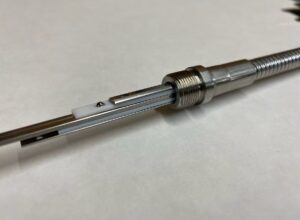
Why Consider a Ball Bearing Control Cable?
Ball bearing control cables are designed for demanding push-pull applications where precise movement, low friction, high mechanical efficiency and reduced lost motion are important.
Cablecraft offers KRF3000 and KRF1600 options with different published load and bend-radius capabilities. Final selection must account for routing, mounting, temperature, covering, load, duty, compression stroke and program requirements.
KRF3000 and KRF1600 Ball Bearing Control Cable Comparison
Use the values below as initial series-level reference points. Final cable selection requires a complete application and configuration review.
| Specification | KRF3000 | KRF1600 | Why It Matters |
|---|---|---|---|
| Series | Series 400 | Series 600 | Series selection affects load, bend radius, weight and packaging. |
| Normal-Duty Load | 100 lb recommended maximum tension and compression | 500 lb recommended maximum tension and compression | Normal-duty classification is tied to published lifecycle assumptions. |
| Limited-Duty Load | 300 lb recommended maximum tension and compression | 1,000 lb recommended maximum tension and compression | Limited-duty capability must not be treated as a continuous-duty rating. |
| Minimum Bend Radius | 4 in | 7 in | Tighter routing can increase friction, stress and wear. |
| Recommended Extended-Life Radius | 7 in | 12 in | Larger bend radii generally support improved operating life. |
| Efficiency | 90%–98% | 90%–98% | Higher efficiency reduces the force lost through the routed system. |
| Bare-Control Temperature | -65°F to +450°F | -65°F to +450°F | Covering and configuration change the applicable temperature limits. |
| Lubrication | Not required | Not required | Dry-running construction reduces routine lubrication requirements. |
Engineering note: Normal duty assumes a published minimum product life of 100,000 cycles. Rated compression loads are limited to a 4-inch maximum stroke. Covering, routing, bend radius, support, fittings, environment and program requirements must be confirmed for the specific application.
Choose the Right Aerospace Control Architecture
The product category should be selected from the complete motion-control requirement, not from one load or dimensional value alone.
| Solution | How It Works | Common Aerospace Uses | Key Engineering Inputs |
|---|---|---|---|
| Ball Bearing Push-Pull | Uses ball-bearing elements to transfer bidirectional motion efficiently with low lost motion. | Aircraft and helicopter flight controls, engine controls and demanding long-routing applications. | Normal and peak load, duty, routing, bend radius, temperature, covering, stroke and mounting. |
| Sliding Push-Pull | Transfers movement in tension and compression through a routed conduit and innermember system. | Throttle, engine, cowling, adjustment and other bidirectional controls. | Push and pull load, travel, routing, column strength, conduit, lost motion, fittings and alignment. |
| Pull-Pull / Pull-Only | Transfers tension and uses an opposing cable, return spring or mechanism for return movement. | Flight controls, brakes, seat release, latches, cowlings, doors and cabin release functions. | Pull load, return method, stretch, travel, routing, fittings, environment and alignment. |
| Cycle-Flex™ Miniature | Uses compact stranded cable for small-package or repeated-motion applications. | Overhead-bin latches, compact releases, reciprocating mechanisms and safety tethers. | Diameter, construction, pulley or bend geometry, coating, lubrication, fittings and cycle requirement. |
| Safety / Restraint | Captures, secures or limits movement instead of continuously transmitting control motion. | Cargo doors, emergency hatches, equipment restraint, access panels and safety tethers. | Working load, safety factor, cable construction, coating, corrosion, length, fittings and attachment points. |
| Remote Actuation System | Combines a cable with a lever, handle, button, release mechanism or other operator interface. | Seat release, recline, door latching, locking gas springs, bins and cabin controls. | Input force, travel, ergonomics, output mechanism, packaging, installation and service requirements. |
Common Aerospace Control Cable and Actuation Applications
Cablecraft products support primary, redundant, cabin, access, restraint and support-equipment functions across commercial, military and general aviation programs, subject to application and program approval.

Flight & Engine Controls
- Aircraft flight-control systems
- Helicopter flight controls
- Engine and throttle controls
- Brake-control applications
- Long and complex routed controls
Cabin & Seating Systems
- Seat release and adjustment
- Seat recline mechanisms
- Locking gas-spring actuation
- Overhead-bin latch systems
- Lavatory and interior controls
Doors, Hatches & Cowlings
- Aircraft door release
- Emergency-hatch actuation
- Engine-cowling controls
- Access-panel restraint
- Luggage and service doors
Restraint & Support Equipment
- Safety tethers
- Equipment lock-down systems
- Cargo and door restraint
- In-service equipment controls
- Ground-support applications
From Aerospace Application Review to Production
Cablecraft works with engineering, sourcing, quality and program teams to define the requirement, select the architecture, verify the design and support a controlled launch.
Define Requirements
Review motion, load, travel, routing, temperature, environment, interfaces, duty, documentation and timing.
Engineer the Architecture
Select cable type, construction, conduit, fittings, controls, materials, sealing, mounting and related components.
Prototype & Validate
Confirm dimensions, interfaces and function, then evaluate appropriate lifecycle, durability or program testing.
Launch & Support
Coordinate manufacturing, inspection, quality documentation, sourcing and ongoing program or lifecycle support.
Information That Speeds Up an Aerospace RFQ
Complete technical and program inputs help Cablecraft determine whether an existing, modified-standard or custom solution should be evaluated.
- Motion direction
- Normal and maximum loads
- Travel or stroke
- Overall length and routing
- Bend locations and radii
- Temperature range
- Contaminants and environmental exposure
- Cycle-life or duty requirement
- Mounting and end fittings
- Allowable lost motion
- Drawings, models or samples
- Program and documentation requirements
Engineering-Supported Alternate-Source Reviews
Cablecraft can evaluate legacy, MRO, spares and alternate-source requirements when an existing aerospace control cable or actuation product is difficult to source, obsolete or affected by supply risk.
A competitor part number alone does not establish fit or interchangeability. Length, stroke, load, routing, mounting, fittings, environment, qualification and program requirements must be reviewed.
Explore product line transfer capabilities →Provide Existing Information
Share the current part number, drawing, specification, photographs, sample and known application data.
Confirm Critical Requirements
Review fit, function, travel, load, routing, fittings, materials, environment and program controls.
Prototype & Evaluate
Develop an appropriate candidate and complete agreed dimensional, functional and validation activities.
Control the Transition
Coordinate approval, quality documentation, manufacturing, sourcing and production introduction.
Quality Systems Supporting Aerospace Programs
Cablecraft supports applicable aerospace and defense programs through documented quality systems, application engineering, controlled manufacturing, inspection, prototyping and test planning.
The current Cablecraft certification page lists AS9100D with ISO 9001:2015 and ITAR registration for the St. Matthews, South Carolina facility.
View certifications and facility scope →Aerospace quality management requirements supporting the applicable certified facility and scope.
Documented systems supporting process control, corrective action and continual improvement.
Supporting applicable programs requiring controlled handling of technical or program information.
Dimensional review, prototypes, functional evaluation and appropriate lifecycle or durability test planning.
Certification, registration, test and compliance applicability varies by Cablecraft facility, process, product, configuration and program scope. Confirm the requirements of the specific aerospace or defense application with Cablecraft.
Need Rod Ends, Spherical Bearings or Linkage Assemblies?
Radial Bearing, part of the Cablecraft family, supports aerospace and defense applications requiring articulation, misalignment accommodation, load transfer, rod ends, spherical bearings and complete engineered linkage assemblies.
Aerospace Engineering and Sourcing Resources
Use these resources to compare control architectures, prepare application inputs, review technical considerations and confirm facility-specific quality scope.
Ball Bearing Control Cables
Review product benefits, published characteristics, design considerations and KRF series information.
View ball bearing cable information →Engineering Design Guides
Review cable selection, conduit, bend radius, lost motion, stretch, fittings and system-design resources.
Browse Cablecraft engineering resources →Aerospace Specification Guide
Review the application variables that influence routing, load, stroke, temperature and long-term cable performance.
Read the aerospace specification guide →Certifications & Facility Scope
Review current ISO, AS9100D and ITAR documentation by Cablecraft facility and confirm applicability to the program.
View certification documents →Aerospace Control Cable FAQs
Direct answers to common questions from aerospace engineers, sourcing teams, quality professionals, MRO organizations and program managers.
What aerospace products does Cablecraft manufacture?
Cablecraft manufactures and supplies ball bearing control cables, sliding push-pull controls, pull-pull and pull-only cables, safety and restraint assemblies, Cycle-Flex miniature cables and remote actuation systems for applicable aerospace and defense programs. Rod ends, spherical bearings and linkage assemblies are available through Radial Bearing.
When should a ball bearing control cable be considered?
A ball bearing control cable may be considered when the application requires efficient and accurate bidirectional motion transfer, low lost motion, high repeatability, demanding load capability or long and complex routing. Final selection depends on load, duty, bend radius, routing, mounting, temperature, covering, stroke and program requirements.
What is the difference between push-pull and pull-pull aircraft control cables?
A push-pull control cable transfers movement in both tension and compression. A pull-pull or pull-only cable transfers tension and normally relies on an opposing cable, return spring or the controlled mechanism for return movement. The correct architecture depends on load direction, routing, travel, precision and system geometry.
Can Cablecraft design a custom aircraft control cable?
Yes. Cablecraft can evaluate cable type, construction, conduit, overall length, travel, fittings, materials, covering, sealing and mounting features around the requirements of the specific aircraft or aerospace application. Drawings, models, photographs, samples and complete operating conditions help accelerate the engineering review.
Does Cablecraft support prototypes and testing?
Cablecraft can provide prototypes to help confirm dimensional, tolerance, routing and interface requirements. Functional, lifecycle and durability testing can be evaluated based on the product, configuration, application and program requirements.
Can Cablecraft evaluate an obsolete or alternate-source aerospace cable?
Yes. Cablecraft can evaluate legacy, MRO, spares and alternate-source requirements through an engineering review. An existing part number does not by itself establish a direct replacement. Fit, function, dimensions, load, stroke, routing, fittings, environment, qualification and program requirements must be confirmed.
What aerospace certifications does Cablecraft maintain?
The current Cablecraft certification page lists AS9100D with ISO 9001:2015 and ITAR registration for the St. Matthews, South Carolina facility. Certification and registration applicability depends on facility, process, product, configuration and program scope and should be confirmed for the specific requirement.
Can Cablecraft assemblers produce aerospace or ball bearing control cables?
No. Aerospace and ball bearing control cables are available directly through Cablecraft and are not produced through the Cablecraft Assembler Network. These products require specialized manufacturing, quality controls, testing, traceability and, where applicable, aerospace-specific compliance requirements.
What should be included in an aerospace control cable RFQ?
Include motion direction, normal and maximum loads, travel, overall length, routing, bend locations, temperature, environment, cycle-life or duty requirements, allowable lost motion, fittings, mounting, annual quantity, program timing and applicable quality or documentation requirements. Attach drawings, models, photographs or a physical sample when available.
Start an Aerospace Motion Control Project
Share your application, drawing, required motion, load, travel, routing, environment, interfaces, qualification requirements, annual quantity and program timing. Cablecraft will help evaluate the appropriate ball bearing, push-pull, pull-pull, restraint, miniature, actuation or linkage approach.